

Trump’s UFO File Releases Spark Debate Over Space, Secrecy, and Hidden Programs
President Trump has promised greater transparency surrounding UFOs, unidentified anomalous phenomena (UAPs), and government secrecy, with official records being released in stages. According to the host of a recent roundtable discussion, more than one billion visits have been recorded on the Department of War’s UFO information page, reflecting extraordinary public interest in the subject.
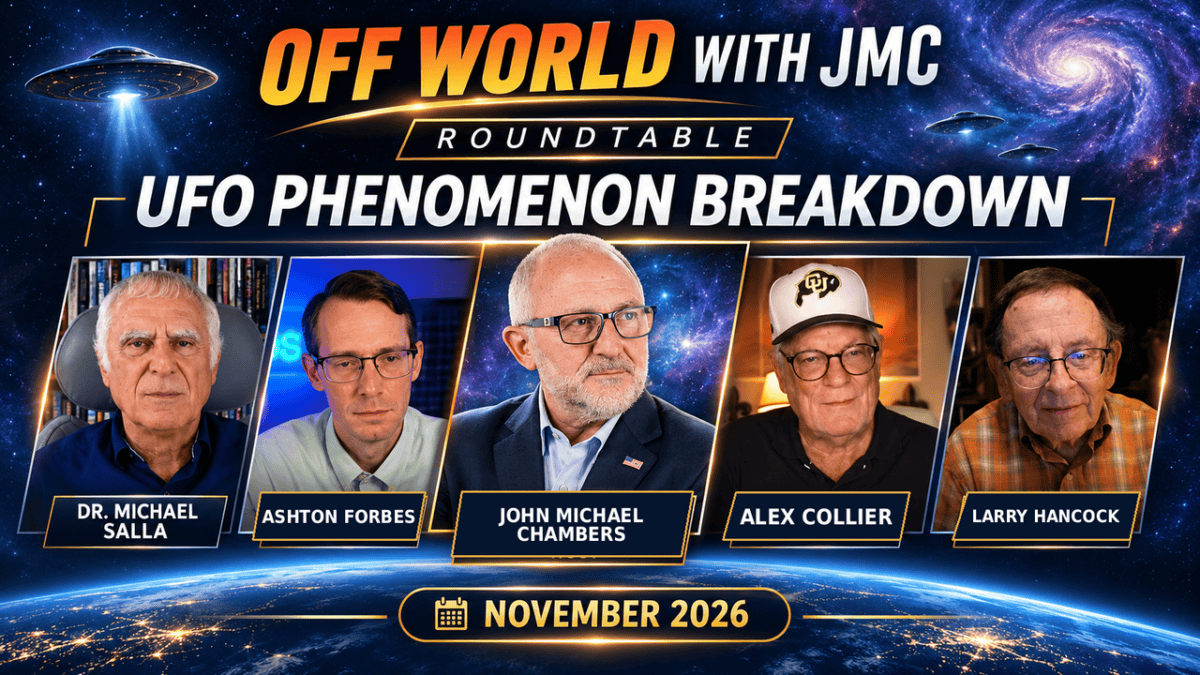
Yet the government files represent only one part of a much larger conversation. During this November 2026 edition of Off World With JMC, titled UFO Phenomenon Breakdown, John Michael Chambers, Dr Michael Salla, Ashton Forbes, Alex Collier and Larry Hancock explore presidential awareness, emerging space policy, classified military programs, advanced technologies, and the wider implications of disclosure.
The discussion examined not only what governments have revealed, but also what the panel believes may lie behind decades of secrecy and how future developments could reshape public understanding of humanity’s place in the universe.
What the Government Has Released So Far
The release of UFO-related information is taking place through several channels, with the Pentagon’s All-domain Anomaly Resolution Office (AARO) and congressional oversight committees playing important roles.
During the roundtable, the panel explained that multiple disclosure streams are operating simultaneously. Some information has emerged through congressional hearings, where military pilots, intelligence personnel, and whistleblowers have provided testimony about encounters with unidentified objects and concerns surrounding classified programs.
Other material has come through AARO, including military video recordings and information concerning anomalous objects observed in American and international airspace.
An important distinction raised during the conversation was that much of the material being circulated is historical rather than newly discovered.
The panel discussed how a substantial proportion of UFO documentation dates back several decades, with numerous records having entered the public domain through earlier declassification efforts.
The significance of these releases may therefore extend beyond the documents themselves. By making historical records more accessible, the government is encouraging renewed public examination of events, testimony, and military observations that have remained controversial for generations.
The broader question is what the public will do with this information and whether additional disclosure will provide a clearer picture of the technologies and organizations involved.
Presidential Awareness and the Question of What Trump Knows
One of the central themes of the discussion concerned President Trump’s level of awareness regarding UFOs, classified aerospace programs, and the possibility of a much larger disclosure process.
The panel explored the idea that developments since 2017 have followed a gradual trajectory toward greater public acknowledgment of unidentified aerial phenomena.
That year marked an important turning point when major news organizations published reports concerning military UFO investigations and previously classified government initiatives.
Since then, congressional inquiries, military task forces, whistleblower testimony, and successive releases of official information have brought the subject into mainstream political and national security discussions.
One perspective presented during the roundtable was that gradual disclosure may be intentional.
After decades in which UFO reports were frequently dismissed or ridiculed, a sudden announcement involving advanced non-human technologies or previously concealed programs could have far-reaching social, political, and economic consequences.
A carefully managed release of information could provide governments and institutions with an opportunity to prepare the public for more significant revelations.
The discussion also examined 2027 as a potentially important year for further disclosure, with the possibility that the current sequence of developments could lead to a more substantial announcement.
Other perspectives focused less on extraterrestrial questions and more on the strategic value of advanced technology.
The panel considered whether revolutionary energy systems, unconventional propulsion, and highly classified military research might represent some of the most important secrets associated with the UFO phenomenon.
These subjects were also connected to the rapidly increasing energy requirements of artificial intelligence, data centers, and future technological infrastructure.
From this perspective, the disclosure debate is not solely about the existence of life beyond Earth. It may also involve technologies capable of transforming energy production, transportation, defense, and the global economy.
The American Declaration of Freedom in Space
A major topic of the discussion was the American Declaration of Freedom in Space, described during the broadcast as a White House policy document released on November 3, 2026.
The panel explored its possible implications for American space strategy, international competition, and the future governance of activity beyond Earth.
One interpretation was that the declaration signals a more assertive American approach to establishing the principles that will shape access to and activity in space.
Rather than allowing rival powers to determine the rules governing strategic locations and resources, the United States appears intent on maintaining freedom of access and protecting its long-term interests.
The conversation also examined the declaration through the lens of military strategy and commercial development.
Space is increasingly important for communications, navigation, surveillance, scientific research, resource exploration, and national defense.
The principle that no nation should monopolize access to orbital pathways or claim exclusive control over celestial territory was compared to historical American positions concerning freedom of navigation on the world’s oceans.
China’s expanding lunar ambitions and broader space capabilities were highlighted as important factors shaping the strategic environment.
The declaration was also discussed in relation to the United States Space Force, established during the first Trump administration, and the proposed Golden Dome missile defense system.
Together, these initiatives were interpreted as elements of a wider effort to strengthen America’s technological and military position beyond the atmosphere.
What initially appeared to some observers as an unconventional military development may increasingly be viewed as part of a long-term strategic transformation.
Why Off-World Issues Matter Here on Earth
A central question raised during the broadcast was why Americans should devote attention to off-world subjects when domestic issues such as housing affordability, border security, economic uncertainty, and national debt remain pressing concerns.
The panel approached this question from several different directions.
One argument emphasized that identifying and assessing unknown objects operating within national airspace is a fundamental responsibility of military and intelligence organizations.
If unidentified craft demonstrate unusual capabilities or operate near sensitive installations, understanding their origin, technology, and intentions becomes an important national security issue.
The discussion also explored the possibility that opportunities for meaningful communication may have been overlooked.
This was compared with the Search for Extraterrestrial Intelligence (SETI), which searches for signals from distant star systems while questions remain about unexplained activity much closer to Earth.
Another perspective focused on technological change and public education.
Emerging technologies are already reshaping society, and the panel emphasized the importance of understanding developments that could influence energy, communications, computing, aerospace engineering, and future economic opportunities.
The conversation then turned to classified government spending.
A figure exceeding one trillion dollars was discussed in connection with alleged hidden programs, undisclosed technological development, and the broader financial structures supporting classified operations.
The panel linked these concerns to longstanding questions surrounding Pentagon accounting, financial transparency, and the difficulty of tracing expenditure through complex defense systems.
The broader issue was whether resources devoted to secrecy and classified technological research might eventually be redirected toward public benefit.
Advanced propulsion, new energy sources, and other potentially transformative discoveries could have substantial implications for everyday life if made more widely available.
Claims About Children and Off-World Trafficking
One of the most serious and emotionally charged parts of the discussion concerned allegations of human trafficking connected to off-world activities.
The panel explored accounts suggesting that children may have been transported beyond Earth as part of concealed operations involving highly advanced space capabilities.
The conversation also raised concerns regarding adults, specialized workers, and individuals allegedly recruited or transported into secret programs.
These accounts were presented within a wider discussion of hidden space infrastructure, unconventional military operations, and the possibility that networks operating beyond ordinary public oversight have existed for decades.
Connections were also drawn between alleged historical German space programs, corporate structures, and later developments in secret aerospace technology.
The panel considered the potential human consequences of such activities and the profound impact their exposure could have on society.
One particularly striking concept was described as “humanity’s dark night of the soul.”
This expression referred to a possible period of collective shock, grief, and reassessment if information concerning the full extent of alleged hidden operations were brought into public view.
The discussion suggested that future disclosure could involve much more than questions about unidentified craft or extraterrestrial life.
It could also raise difficult questions about institutional accountability, human rights, and the responsibilities of governments and organizations operating behind national security protections.
The seriousness of these allegations made the potential need for transparency, documentation, and accountability an important part of the conversation.
The Blackout Warnings and the Panel’s Competing Views
The discussion later turned to emergency preparedness, infrastructure vulnerabilities, and a series of developments that the host considered potentially connected.
Among the events discussed was a September 30 directive reportedly advising military installations to prepare for the possibility of operating without civilian support systems for up to 90 days.
The host also referred to reports of warnings about potential blackouts across 56 countries, alongside a national emergency alert test described as scheduled for November 17, with December 3 identified as an alternative date.
An explosion in Palm Beach, Florida, was mentioned as another event attracting attention during the same period.
These developments prompted a wider conversation about whether governments and military organizations are preparing for significant disruptions.
The panel offered several interpretations.
One perspective anticipated a period of institutional accountability, major arrests, and the exposure of corruption within powerful organizations.
Another described the possibility of extensive military operations directed toward entrenched networks of influence, accompanied by significant changes involving political institutions and the media.
Other viewpoints emphasized established national security concerns rather than broader political predictions.
Cyberattacks, attacks on energy infrastructure, interruptions to data centers, and disruption of airline operations were all identified as risks that modern governments must take seriously.
The panel noted that military installations have historically maintained emergency power generation, fuel reserves, and continuity plans to ensure critical operations can continue during major disruptions.
Preparing for extended power outages or failures of civilian infrastructure is therefore an important component of national defense planning.
The disagreement highlighted different ways of interpreting the same developments.
While some participants viewed emergency preparations as possible indicators of extraordinary events, others placed greater emphasis on conventional defense requirements, cybersecurity, and infrastructure resilience.
Despite their differences, the discussion reinforced the importance of preparedness and the need for continued public attention to national infrastructure security.
The Bigger Picture: Disclosure, Technology, and Accountability
Throughout the roundtable, a recurring theme was the relationship between public disclosure and the concentration of technological knowledge.
UFO investigations are often presented primarily as a question of whether humanity is alone in the universe.
The discussion suggested a much wider set of possibilities.
If advanced aerospace or energy technologies have been developed within restricted programs, questions arise about who controls those discoveries, how they are funded, and what their release could mean for society.
The panel also connected space policy with national security, economic competition, scientific research, and the development of future infrastructure.
Advances in propulsion, energy generation, artificial intelligence, and space-based systems could change the strategic balance between nations while opening new possibilities for civilian life.
At the same time, the conversation raised questions about the relationship between secrecy and democratic oversight.
How much information should remain classified in the interests of national security? At what point does secrecy interfere with accountability? And how should the public participate in decisions involving technologies or discoveries that could affect humanity as a whole?
These questions are central to the continuing debate over UFO disclosure.
What Viewers Should Take Away
The November 2026 Off World With JMC roundtable, UFO Phenomenon Breakdown, brought together a wide range of perspectives on government disclosure, classified technologies, space policy, emergency preparedness, and the possibility of major revelations in the years ahead.
The discussion moved between historical government records, congressional investigations, military strategy, firsthand accounts, and expectations about future developments.
Although the panel offered different interpretations of events, several important themes emerged.
Government transparency remains a central concern. National security and space policy are becoming increasingly interconnected. Advanced technologies could have implications far beyond military applications. And the social consequences of future disclosure deserve serious consideration.
The discussion also highlighted the importance of examining official records, congressional testimony, policy announcements, and firsthand accounts as new information becomes available.
With increased attention on UFO investigations and the expanding role of space in American strategic planning, the coming years may prove especially important for public understanding of these subjects.
Ultimately, the responsibility for following developments, examining the information, and asking meaningful questions belongs to the public.
As the host emphasized during the broadcast:
“It’s up to us.”
- John Michael Chambers – https://johnmichaelchambers.com/
- Dr. Michael Salla – https://www.exopolitics.org/
- Ashton Forbes – https://x.com/ashtonforbes/
- Larry Hancock – https://larryhancock.wordpress.com/
- Alex Collier – https://www.alexcollier.org
Please Donate To Alex Collier. Anything You Can Afford Will Be Appreciated